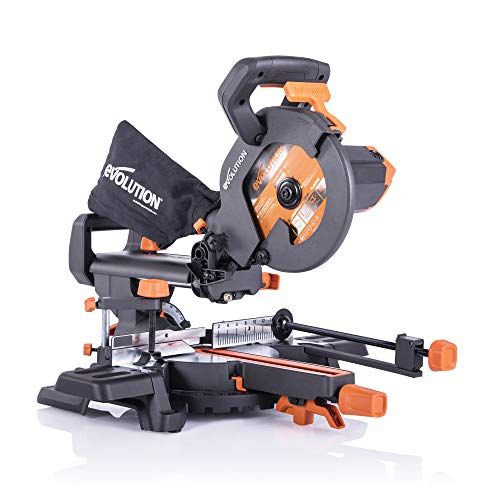
Choosing the right mitre saw depends entirely on the complexity of your joinery and the materials you handle. From basic manual boxes for quick trim work to professional sliding compound saws capable of cutting through metal and thick timber, the options vary significantly in precision and power. Our selection focuses on cutting capacity, bevel accuracy, and versatility to help you find a tool that matches your specific workshop needs.
Updated This Week
10
products
75-133€
Price Range
Interactive Comparison
As an Amazon Associate we earn from qualifying purchases.
The saw head can be tilted continuously to the left and right for high flexibility in setting mitres on two sides. The integrated drag function enables you to cut particularly wide workpieces.
Workpiece supports on two sides, a clamping device for reliable securing of the workpiece and a workpiece stop with rails that adjust to the left and right enable safe, precise operation.
The mitre block and saw has a guide for cutting at a 45 degree angle from left and right and also a straight cut guide line for when precision straight cuts are needed
The hand saw is 300mm (12") long and 0.9mm thick with 13 TPI and is manufactured from carbon steel for strength and durability
POWERFUL MOTOR: New 1400 Watt motor for powerful cutting in all materials
HIGH PERFORMANCE, CLEAN CUTS: With a maximum cut depth of 70mm, a power output of 1,100W and a no load speed of 6,300rpm, the DWS774 is capable of tackling large material cuts with ease
For most users, a sliding compound saw provides the best versatility. However, for those with limited space, the convertible table/mitre models offer impressive utility.
Market Overview: mitre saw
AI
The market is shifting toward multi-material capability, with more saws designed to handle plastic and aluminium alongside traditional timber.
Buying Guide: mitre saw
AI
When shopping for a mitre saw, prioritise the cutting width and the range of bevel angles. Consider whether you need a portable manual box or a heavy-duty powered station.
Selection Criteria
Products were selected based on user feedback, build quality, versatility of materials handled, and the balance between price and performance.
Budget Advice
AI
Entry-level manual boxes are very affordable. Mid-range powered saws offer the best value for DIY, while premium sliding models are investments for professional use.
Conclusion: mitre saw
AI
Whether you are fitting skirting boards or building custom furniture, the right saw makes the difference between a gap and a seamless joint. Explore our full list to find the best match for your project.
Frequently Asked Questions
AI
A standard mitre saw only cuts angles across the face of the board. A compound mitre saw can tilt the blade (bevel) as well as rotate it, allowing for complex angled cuts used in crown moulding.
Sliding saws allow the blade to move forward and backward, significantly increasing the width of the material you can cut compared to a fixed-arm saw.
Only if the saw is specifically designed for multi-material cutting and equipped with a TCT blade rated for metal. Standard wood-cutting blades will be damaged by metal.
We use Google Analytics to measure site usage. In the EEA, UK and Switzerland, analytics cookies require your consent; without consent, only cookieless signals are sent. Elsewhere, measurement is enabled by default and you can decline. Declining does not limit access to the site.
Learn more